
Why Planners Often Fail for Women with ADHD
Why do planners often fail for women with ADHD? Learn how time blindness, overwhelm, and rigid systems make traditional planners hard to use—and what helps instead.
ADHD & FOCUS
T.J. Merritt
5/6/20268 min read
Why Planners Often Fail for Women with ADHD
Have you ever bought a beautiful new planner, filled in the first week with neat handwriting, color-coded a few categories, and felt like this might finally be the system that works? Then by day six, you had missed a few boxes. By day ten, the planner was under a stack of mail. By day fourteen, looking at it made your stomach tighten.
If that sounds familiar, you are not alone. And no, it does not mean you are lazy, careless, or incapable of getting organized.
For many women with ADHD, planners fail because they are often designed for brains that already have a steady sense of time, task order, and follow-through. A traditional planner assumes you can estimate how long things take, remember to check the plan, shift smoothly from one task to another, and keep a mental timeline running in the background of your day.
That is a lot to ask from a brain already working hard to manage attention, time blindness, transitions, and daily demands.
The problem may not be that you need a prettier planner. The problem may be that the planner is asking your brain to do work it does not reliably do on its own.
The Hidden Problem with Most Planners
Most planners are passive. They sit on the desk. They stay in the bag. They wait inside an app. They hold the plan, but they do not interrupt the drift.
That can be a problem for women with ADHD because the issue is often not knowing what needs to be done. Many women with ADHD know exactly what needs doing. The harder part is noticing when to start, when to stop, how much time is left, and when “I’ll do that in a minute” has quietly turned into half an hour.
A standard planner expects you to remember to look at it. It expects you to feel fifteen minutes passing. It expects you to notice when one task is running long. It expects you to move from planning into action without losing momentum.
For a time-blind brain, that is a weak setup. The planner may be accurate, organized, and beautifully designed, but it still depends on an internal time system that may not be dependable.
It is a little like being handed a map in a language you cannot read well. The map may be technically correct, but it does not help much when you are trying to navigate real life in motion.
Why Time Blindness Makes Planning Harder
Time blindness is a common ADHD-related struggle that makes it difficult to sense, estimate, and manage time. This can show up in ordinary ways:
You think a task will take ten minutes, but it takes thirty.
You sit down for a quick break, and forty minutes disappear.
You know you need to leave soon, but “soon” does not feel urgent until you are already late.
You write a reasonable to-do list, then realize later that it would have required three extra hours you did not actually have.
This is one reason planners can feel so discouraging. On paper, the day looks possible.
In real life, every task has hidden edges: setup time, cleanup time, decision time, transition time, interruption time, and recovery time. A planner may give you a neat line that says “clean kitchen,” but your brain still has to determine what that means, how long it will take, when to begin, and how to stop before the whole day disappears. That is a lot of invisible work.
Rigid Systems Break Quickly
Many planners are built around ideal days. They give you morning routines, habit trackers, meal plans, gratitude sections, water intake boxes, goal pages, weekly reviews, priority grids, and maybe a place to rate your mood.
Some of those tools can be useful. The trouble begins when the system becomes too heavy to carry. A planner packed with categories may feel exciting on the first day. It gives the impression that life is about to become orderly. But when a hard week comes, the system can start to feel like one more person asking, “Why didn’t you keep up?” That is when planner guilt sets in.
You miss one day, then two. The blank spaces start looking like evidence. Instead of helping you restart, the planner reminds you that you fell behind. For many women with ADHD, this is where the shame spiral begins.
“I always do this.”
“I waste money on planners.”
“I can’t stick with anything.”
“Why can’t I just be consistent?”
But a system that only works during your best week is not a dependable system. Real life includes sick kids, bad sleep, late meetings, hormonal shifts, emotional overload, interruptions, and days when your brain simply does not cooperate.
Your planning tools need to survive those days too.
The Planner Is Often Too Far Away
Another problem is visibility. A closed planner is easy to forget. Even a good planner can disappear once it is shut. If it is in another room, inside a tote bag, under papers, or buried in an app, it is no longer supporting you in the moment you need it.
Women with ADHD often benefit from cues that are hard to miss. That usually means the information needs to be visible, simple, and placed where the task actually happens. A task list hidden in a planner may not help when you are standing in the kitchen wondering what you were about to do. A reminder buried in an app may not help when your phone has already pulled you into something else.
The best support is usually close to the point of action. If the task belongs in the bathroom, the cue may need to be on the bathroom mirror. If the task belongs by the door, the cue may need to be by the door. If the task belongs at your desk, the cue may need to be visible from your chair.
The easier something is to see, the less your brain has to retrieve it from memory.
What Helps Better Than a Traditional Planner
This does not mean all planners are useless. Some women with ADHD do use planners well, especially when the planner is simple, visible, and paired with reminders.
But if traditional planners keep failing you, it may be time to stop trying to force a paper system to carry the whole load. Instead, try external supports that make time and tasks easier to see, hear, and respond to.
1. Make Time Visible
Digital clocks tell you the time, but they do not always help you understand how much time is left.
If it is 7:42 and you need to leave at 8:15, your brain still has to do the math. On a calm day, that may be easy. During a rushed morning, it may not happen fast enough to help.
An analog clock can be more useful because it turns time into space. You can see the distance between now and when you need to leave.
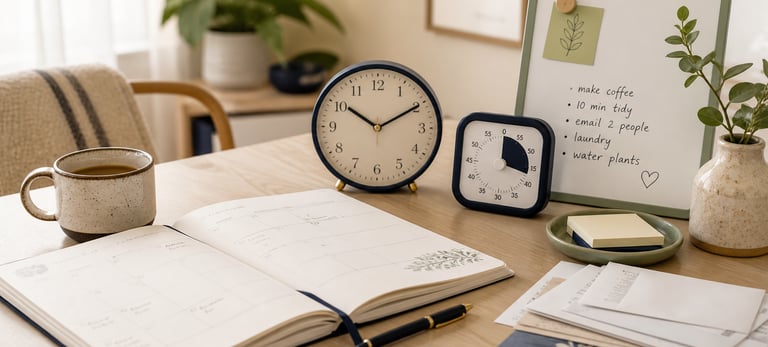
A visual timer can help for the same reason. Timers with a shrinking colored disc show time disappearing in a way your brain can notice without doing calculations.
That matters because ADHD time blindness often needs something more concrete than numbers on a screen. Try putting an analog clock or visual timer in one place where time regularly disappears: the bathroom, kitchen, desk, laundry area, or bedroom.
Keep it where your eyes naturally go. A time tool you cannot see will not help when you need it most.
2. Put Tasks Where You Will Actually See Them
Instead of hiding your most important tasks inside a planner, put them in your line of sight. A small whiteboard can work well. So can a sticky note, index card, or simple notepad. The tool does not need to be impressive. It needs to be visible.
For example:
On the bathroom mirror:
Brush teeth. Medication. Hair. Shoes. Bag.By the door:
Keys. Wallet. Water. Lunch. Leave by 8:15.On your desk:
Today: email Sarah, pay invoice, finish chapter notes.
The goal is to reduce retrieval. You are not depending on your brain to remember the plan. You are placing the plan where your eyes can catch it. Keep the list short. A visible list with three useful items is better than a perfect list with twenty-seven tasks that makes you want to avoid it.
3. Use Audio Nudges
Sometimes your brain needs a sound cue to bring you back to time. This does not have to be a harsh alarm. In fact, jarring alarms can create stress, especially if they make every transition feel like a small emergency.
Gentler audio cues often work better. You might use interval chimes every ten or fifteen minutes during a morning routine. You might use a playlist as a timer. You might choose a specific song that means, “It is time to start wrapping up.”
A playlist can be especially helpful because it lets you feel the routine moving forward. By the second song, you should be dressed. By the fourth song, you should be packing your bag.
By the final song, you should be heading to the door.
That kind of cue gives your brain a rhythm to follow without requiring constant clock-checking.
4. Keep Any Planner Simple and Secondary
If you still want to use a planner, make it serve a smaller job. Do not ask it to manage your entire life, emotions, habits, goals, meals, appointments, chores, finances, and personal growth all at once.
Let it hold the bigger picture. Then use visible cues, timers, and reminders to help you move through the day.
A planner may work better as a weekly overview than a minute-by-minute command center. You might use it to write down appointments, deadlines, and three priorities for the week. Then each morning, transfer only the most important items to a visible note or whiteboard.
That way, the planner is not the whole system. It is one part of a larger support structure.
A Better Question Than “Which Planner Should I Buy?”
The better question may be: Where does my day usually fall apart?
Is it when you are trying to leave the house? Starting work? Stopping work? Remembering meals?
Getting off your phone? Beginning chores? Going to bed?
Once you know the trouble spot, you can place support there. If mornings fall apart, start with a visual timer in the bathroom or kitchen. If leaving the house is the problem, create a simple launch area by the door. If work tasks vanish, put a three-item list where you can see it from your chair. If bedtime drifts later and later, use an evening playlist or recurring chime that begins before you are exhausted.
Do not try to fix every routine at once. That is how a support system becomes another source of pressure. Choose one place. Add one cue. Give it a real chance.
Your Planner Graveyard Is Not Proof That You Failed
If you have abandoned planners before, that history does not mean you are broken. It may simply mean you were handed tools that depended too much on memory, motivation, and an internal sense of time.
Women with ADHD often need systems that are more visible, more flexible, and easier to restart after a hard day. A planner can hold information. But your brain may need time to be seen, tasks to be placed in plain sight, and transitions to be supported before they become urgent.
Start small. Pick the place where your day most often slips away and add one external support: an analog clock, a visual timer, a whiteboard, a sticky note, or a gentle audio cue. You do not need a perfect planner to build a calmer day. You need a system your real life can actually use.
At Poplore Press, we create practical, encouraging resources for real life, including tools for women with ADHD who are tired of systems that look good on paper but fall apart by Tuesday. Watch for upcoming books and workbooks designed to help you build calmer routines, one workable step at a time.
We have one resource available now and one more coming soon.
ADHD Organization Workbook for Women & The Time Blindness System for Women with ADHD
Poplore Press
Independent Self-Publisher
Contact
Stay informed
info@poplorepress.com
© 2026. All rights reserved.