
Helping Children Talk About Big Feelings Through Faith-Based Stories
Faith-based stories can help children talk about fear, worry, sadness, and other big feelings in a warm, gentle way. Here’s how parents and grandparents can use stories to open meaningful conversations.
CHILDREN'S BOOKS
PopPop
5/27/20266 min read

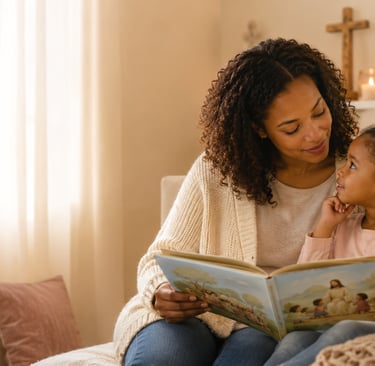
Children feel more than they can always explain.
A child may say, “My stomach hurts,” when they are nervous. They may get quiet when they are sad.
They may act silly when they feel unsure. They may melt down over something small because something bigger has been building all day.
Adults do this too, of course. We just usually have more words for it.
Children are still learning what to call their feelings. They are learning what fear feels like, what worry sounds like, what sadness does to the body, and what anger can make them want to do. They are also learning whether those feelings are safe to talk about.
That is one reason stories matter.
A good faith-based story can give a child a gentle place to recognize what they are feeling without being put on the spot. It can open a door for a parent, grandparent, teacher, or caregiver to say, “Have you ever felt that way?”
Sometimes that one question is enough.
Stories Give Children Language
Big feelings can be confusing for children because they often feel the emotion before they know the name for it. They may know they want to hide, cry, yell, cling, or run away. They may not know whether that feeling is fear, embarrassment, jealousy, loneliness, frustration, or worry.
Stories help by putting feelings into a shape children can see.
A character is afraid of the dark.
A child in the story misses someone.
A little boy feels nervous about something new.
A girl makes a mistake and wonders if she is still loved.
When children see a feeling in a character, they can begin to recognize it in themselves. That is less threatening than asking directly, “Are you scared?” or “Why are you upset?” Sometimes children need a little distance before they can talk honestly. A story gives them that distance.
They can talk about the character first. Then, when they are ready, they may talk about themselves.
Faith-Based Stories Add Something Important
Many children’s books can help with emotions, and that is a good thing. But faith-based stories can add another layer. They can remind children that their feelings are not too big for God.
Fear does not mean God is far away.
Sadness does not mean they are alone.
Anger does not mean they are unloved.
Worry does not mean they have failed.
A gentle Christian children’s book can help children connect their emotional life with God’s care. It can show them that prayer is not only for mealtime or bedtime. It is also for scary mornings, lonely afternoons, hard changes, and moments when they do not have the right words.
That kind of lesson does not have to be heavy. It can be as simple and warm as: “God hears you.”
“God loves you.” “God is near.” “You can talk to Him.”
Children may not understand every theological detail yet, but they can begin to learn that faith belongs in real life.
The Best Conversations Usually Start Small
When a child finishes a story, adults sometimes feel pressure to turn it into a lesson. But children often respond better to conversation than a full explanation. You do not have to ask ten questions. You do not have to correct every answer. You do not have to make the moment bigger than it is.
A small question can be enough.
“What part did you like best?”
“Did anyone in the story feel scared?”
“Have you ever felt like that?”
“What helped the character?”
“What do you think we can remember when we feel that way?”
If the child answers with one word, that is okay. If they change the subject, that is okay too. The goal is not to force a deep conversation every time you read. The goal is to make feelings easier to name over time.
Some conversations happen right away. Others come later in the car, at bedtime, or while a child is coloring at the kitchen table. Stories have a way of staying nearby.
Let the Character Carry Some of the Weight
One of the kindest things a story can do is let a child talk indirectly. A child may not be ready to say, “I am worried about school.” But they may say, “He was scared because he didn’t know what would happen.” That is a beginning.
When we talk through the character, children can explore feelings without feeling exposed. They can test ideas safely. They can notice courage, comfort, forgiveness, or trust from the outside before applying it to themselves.
You might say about a book character: “I think he felt nervous.” “She looked sad when that happened.” “That was a big feeling for him.” “I wonder what helped her feel safe again.”
These comments do not demand a response. They simply model emotional language. Over time, children learn that feelings can be noticed, named, and brought into the open.
Avoid Rushing to Fix the Feeling
This is hard for adults. When a child is afraid, we want to reassure them quickly. When a child is sad, we want to cheer them up. When a child is angry, we want to calm the room down. When a child is worried, we want to explain why everything is fine.
Sometimes reassurance is needed. But if we move too quickly, children may learn that uncomfortable feelings should be hurried away. Faith-based stories give us a better pace.
They can help us sit with a feeling long enough to name it, then gently point toward what is true. The feeling does not have to be the final word. But it does deserve to be heard.
Use Stories Before the Hard Moment Comes
We often reach for helpful books after a child is already upset. That can be good. But stories are also powerful before the hard moment arrives.
A book about fear can prepare a child before the first day of school.
A book about change can help before a move, a new sibling, or a new routine.
A book about sadness can give language before grief or disappointment hits close to home.
A book about God’s love can become a familiar comfort before a child needs to lean on it.
Reading these stories during ordinary days gives children words they may need later. It is a little like placing a flashlight where they can find it when the room gets dark.
Make Room for Hands-On Processing
Some children talk easily. Others process better while doing something with their hands. That is why coloring pages, activity books, drawing prompts, and simple reflection pages can be helpful. A child may say more while coloring than they would say sitting face-to-face.
The activity gives them something to do while the conversation happens naturally. You might ask a simple question while they color: “What color feels calm to you?” “What do you think this child is feeling?” “When do you like to pray?” “What helps you when you feel afraid?”
Again, the point is not to turn every page into a counseling session. It is to create a warm opening. Sometimes the quiet moments are where children say the most.
Read with Warmth, Not Pressure
Children can usually tell when adults are trying too hard to create a “meaningful moment.” The best reading times often feel ordinary. That small moment when a child is leaning against you. A blanket on the couch. Maybe a few minutes before bed. Perfect time for a story.
Faith conversations do not always need a formal setup. Many of them happen in small, repeated moments where a child feels safe. When children know they can ask questions, admit fear, name sadness, and wonder out loud, they are learning something about both family and faith.
They are learning that hard feelings are not shameful. They are learning that God can be part of the conversation.
Where PopPop’s Books Fit
At Poplore Press, the PopPop books are created with those gentle reading moments in mind.
They are written for families who want stories that feel warm, approachable, and rooted in faith. The goal is not to overwhelm children with heavy explanations. The goal is to help them see God’s love and care in everyday experiences they can understand.
PopPop’s Faith Adventures offers faith-centered picture books for families who want to help children connect simple truths about God with ordinary life, family, and growing up. PopPop's Porch in the back of the book offers some helpful conversation starters.
When I Feel… books and activities are especially helpful for children learning to name big feelings like fear, worry, sadness, or uncertainty while remembering that God is near. The book of "big feelings" coloring and activity book keeps hands busy while offering biblical wisdom.
These books are made for laps, couches, bedtime, quiet afternoons, and the kind of conversations that happen one small question at a time.
Final Thought
Helping children talk about big feelings does not always start with a serious conversation. Sometimes it starts with a story. That space can become trust.
Faith-based stories give children more than words for their emotions. They can help children learn that God is near in the middle of those emotions, and that is a gift worth giving.
And it may begin with something as simple as sitting down together and turning the page.
Poplore Press
Independent Self-Publisher
Contact
Stay informed
info@poplorepress.com
© 2026. All rights reserved.